
A couple of days ago I held a community clothes swap in the garden of my friend Monique’s cafe, in Kingaroy. A clothing swap is one small way we can slow down the fast fashion industry and extend the life of our clothes by gifting them to new owners who have the opportunity to love and care for them afresh.
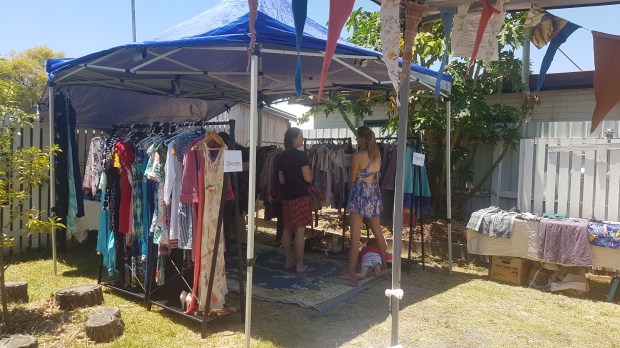
The clothing swap was a really lovely event – clothes were all gifted free of charge or bartering conditions
But what is the fast fashion industry? You have probably noticed it’s possible to buy t-shirts for $4, or jeans for $20 from certain stores. Maybe you have noticed that fashion trends don’t just shift seasonally, but now almost weekly stores are coming out with new trends and items, of which the quality is often poor as clothing are more and more made to be disposable items.
150 billion new garments are produced yearly in the fast fashion industry. 30% of it is never sold, and is instead often incinerated or dumped as overproduced stock. A further 30% is only sold at a discounted price. Of the clothing that makes it to our wardrobes, a large proportion have a lifetime on average of less than 3 years – due to the poor quality and also our attitudes of wanting new things.
When clothing feels this accessible, it seems to create the illusion of abundance – we can feel wealthy and powerful. But what we are not seeing is the true cost of such clothing and our attitudes that create this system.

- Photo by Artem Beliaikin on Pexels.com
When I was a child, I was taught there was a link between my appearance or how I presented myself, how others perceived me, and my worth or loveable-ness. I lacked healthy role models and so chose to look to teen magazines to define myself. I always felt myself to be severely lacking in comparison to the happy beautiful people in those pages. And I readily took on the messages “if I just had this clothing or that body or that boyfriend (and I’d only get the boyfriend if I had the body and the clothing)”, I’d get the kind of happiness I was desperately seeking. I felt compelled to compare myself to others, to find ways to make myself feel better. I lacked a sense of the intrinsic value and worth of developing more meaningful human qualities, below the surface deep exterior.
My early social activities involved “going shopping” with friends. We’d make a day of it, go shop to shop, buying cheap clothing we didn’t need. There was the rush of buying the new outfit with the promise that this is how I’ll be beautiful or liked or sexy or cool. It only ever masked the deeper painful feelings for a short while. I can still remember the awful feeling of staring at myself with bloodshot eyes in the fluorescent lit change room mirrors, wishing to be anyone else.
While I’ve since fluctuated between fast fashion fixes, op-shop sprees, and making my own clothes, I have spent most of my life seeking to define myself through how others perceive me. I’ve used clothing to try to belong, to blend in, to stand out, to be cool, to be worldly, to be liked, to be sexually validated, to compete for a man’s attention. Without much of a sense of who I was behind all that. I feel that when used this way, clothing ourselves could be symbolic of a deeper problem – the problem of presenting a façade to the world to cover over what is really going on inside of us and the yukky feelings we have. It can also be a wonderful and creative form of self-expression! But I’m learning we need to be honest with ourselves about our feelings.
And so, I’ve been wondering whether one of the major reasons the fast fashion industry came into existence is because of the desire to remain in denial of these issues on a large scale – of wanting to hold onto façade and falsity. Coupled with the widespread attitude of entitlement we see – I want what I want, when I want it – and the belief that we have unlimited resources to get anything we possibly can to feel “pleasure” (or avoidance of pain).
I want to introduce the 3 of the areas where there are issues of love, or a lack of love, which I feel contribute to the state of the fashion industry
Love of the environment
When we are single-focused on getting what we want, we sacrifice love and care for our environment.
There are so many environmental consequences of our unloving attitudes towards fashion consumption, I can’t possibly mention them all.
The fashion industry is in fact the second largest polluter in the world after the oil industry. In China, they say you can tell the popular colours of that season by the colour of the rivers. Waterways are filled with toxic poisons from dyeing and tanning processes, which infiltrate and harm the soil, the aquatic life, and the people who depend on such water for growing crops, for drinking, and for bathing with. The ripple effects of this are vast.
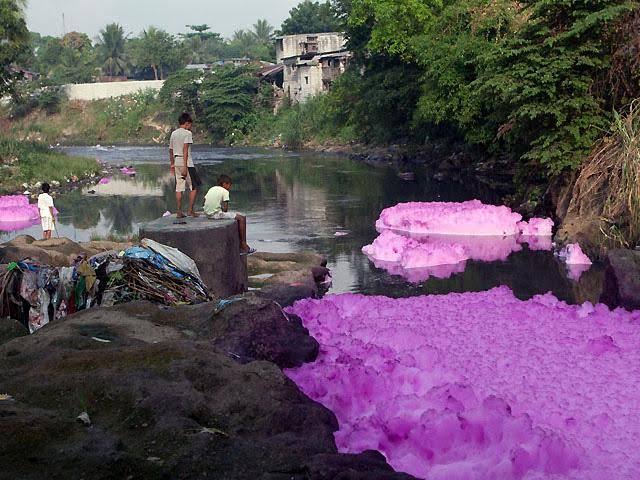
Toxic dyes fill waterways where people live
Just the very quantities of environmental resources required to produce an item of clothing is mindboggling. To give an example: 1 pair of jeans uses 3,625L water (which is enough for 1 person to survive on for 2.5 years), 3kg toxic chemicals, 400 mega joules energy, and 13 meters squared harvested land. Globally we produce about 6 billion pairs of jeans per year!
Then there is the most common end of the line for our clothes; landfill. Australians dump 6000kg of fashion and textile waste every 10 minutes! Much of our clothing these days is made from non-biodegradable plastic-based materials derived from oil that will not break down for hundreds or thousands of years.

These plastic-based materials such as polyester, acrylic and nylon also shed fibres as they go through the washing machine cycle. The laundering of one single polyester garment is estimated to release 1,900 individual plastic fibers; recent studies have found these fibers to be in 83% of the world’s drinking water. The Story of Microfibers – infographic video
Love of others
Once again, when we are single focused on getting what we want, we turn a blind eye to how others are harmed by our desires.
The garment manufacturing industry now comprises 1/6th of the world’s population of our brothers and sisters, mostly sisters, of whom 98% are not paid a living wage. In fact, only 4% of what Australian’s spend on clothes actually goes to the workers and talented tailors and seamstresses who make our garments. This keeps people trapped below the poverty line. When costs are cut in our pursuit of cheaper and cheaper clothing, this is where the margins are squeezed most. Many of these people live in fear of losing their job as there are often limited alternatives, and so are forced to endure horrible conditions; no ventilation, dangerous buildings, no sick leave, unpaid overtime, scarce toilet breaks, child labour… the list goes on.
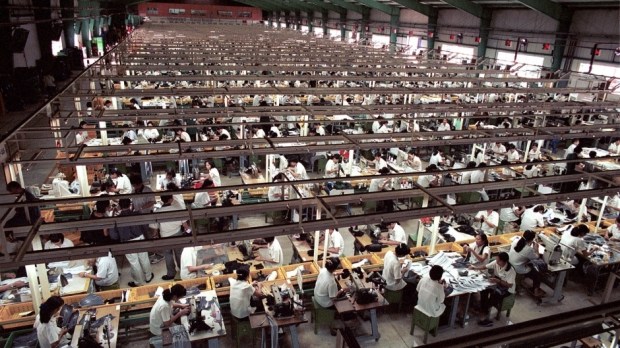
This garment factory in China looks a lot like a human factory farm

Over 1300 workers were killed when this garment factory, the Rana Plaza, collapsed in 2013 in Bangladesh
There are also vastly damaging effects to people caused through exposure to toxic pesticides in the growing phase of garment production, particularly in the cotton industry which is the most chemically intensive crop to grow (accounting for 25% of worldwide insecticide use). Farmers and communities surrounding these farms have incredibly high incidence of cancers and other diseases.
Similarly, people are working with and being exposed to toxic chemicals through the dying of textiles and tanning leather. The amount of clean water available to drink is severely limited in many of these areas.
The ripple effects, once again, are massive!
Love of self
I don’t always know this in my heart, but I get glimpses that it could be true. I think that a real love of oneself will involve wanting to face and take responsibility for the true feelings we have inside ourselves that contribute to the widespread destruction that is happening around us. We’d allow ourselves the time and space to acknowledge, be truthful, and feel through the yukky feelings that we are trying to avoid through the next ‘quick fix’, the buying frenzy, through making things ‘pretty’ on the outside, while covering over what’s on the inside. I think that maybe by going through this process we would learn how to really love and care for others and the environment in a real and effective way, too.

I’ve discovered the joys of sewing out of vintage bedsheets, and also finding my style.
Another aspect of loving ourselves is actually getting to know yourself! Getting to know your personality and nature, style and taste, and what colours and shapes look good on your body and skin tone. When we don’t want to know ourselves, we’re more likely to be at the whim of influence of all kinds, fashion and marketing included – in my experience.
So, what are some helpful actions we can all engage?
- Education – if we don’t want to know about the problem, we won’t ever desire to change it. We can educate ourselves through the abundant resources available about the truth of the effects of our desires and the state of the planet. See resources list at the end.
- “The most ethical piece of clothing is the piece you already own” – keep the clothing we already own in use longer – learn how to make simple repairs, upcycle into something new, swap/gift to friends, learn how to make your own clothes or support local people who do.
- Where possible shop ethically – do the research on fashion labels. From the way materials are grown, how garments are designed, right through the manufacturing process and even into the packaging and postage options, companies are able to engage more ethical processes. If it’s hard to find information about a company’s supply chain, they are not being transparent and may be hiding something you might not want to support. It’s more expensive to buy ethically made clothing, but they will last longer!
- Before dumping a big load of clothes to the local op shop, make sure all clothes are in good condition – something you would give to a close friend. Last year Australian op shops spent 13 million dollars dumping excess clothing and textiles to landfill – money that could have been spent on their charitable projects. For myself, I know that I still have the attitude of wanting someone else to “deal with my crap”, rather than be fully responsible, when I take things to op shops (and in general) much of the time.
- There are many interesting helpful ideas popping up around the world! Bio-clothing grown from fungi or bacteria; circular retailers who take back your clothing purchased from them at the end of use and reuse the fibres; repair kits sold with clothing.

- Choose second hand as a great option!
I don’t believe anything is going to change for the long term in our planet’s majorly destructive industries such as the fashion industry without people really desiring to take responsibility on a deeply personal and emotional level. I feel we need to acknowledge what it is within us that causes us to continue to want to benefit from things that involve others being exploited, or to remain in denial of the truth about these things. I still have a long way to go on these issues personally, but educating myself and beginning the journey of self reflection on my involvement in this industry has been an interesting start.
Additional Resources:
Movies/documentaries:
River Blue (How is fast fashion affecting the world’s waterways?)
http://riverbluethemovie.eco/the-film/
The True Cost (A look inside the fast fashion industry – good overview) http://truecostmovie.com
The New Black (grow your own sustainable clothes? and other interesting ideas)
Earthlings (Human treatment of animals – including a section on the fashion industry)
Websites:
Good on You – helps you to locate ethical clothing brands www.goodonyou.eco/
Shop Ethical www.ethical.org.au
Ethical Clothing Australia www.ethicalclothingaustralia.org.au
Greenpeace: Detox Campaign www.greenpeace.org/international/en/campaigns/detox/#tab=4
 Learning About Love & Truth